
Corticophobia in Eczema: When Fear of Steroid Creams Affects Treatment Outcomes
- Your Health Ally
- May 28
- 2 min read

Topical corticosteroids are one of the most effective treatments for eczema flares. Yet in everyday clinical practice, their effectiveness is often limited not by the medication itself, but by how it is used — or not used — in real life.
One of the most common, yet under-discussed, reasons for suboptimal treatment is corticosteroid phobia, often referred to as corticophobia.
This refers to fear or concern about using topical steroid creams or ointments, particularly around side effects such as skin thinning, dependence, or long-term harm.
While some level of caution is understandable, excessive fear can significantly interfere with treatment outcomes.
How corticophobia appears in practice
Corticophobia is rarely expressed directly as “I am afraid of steroids.” Instead, it is often seen in behaviour.
Patients may:
Apply smaller amounts than prescribed
Stop treatment early once symptoms begin to improve
Avoid using prescribed higher-potency steroids altogether
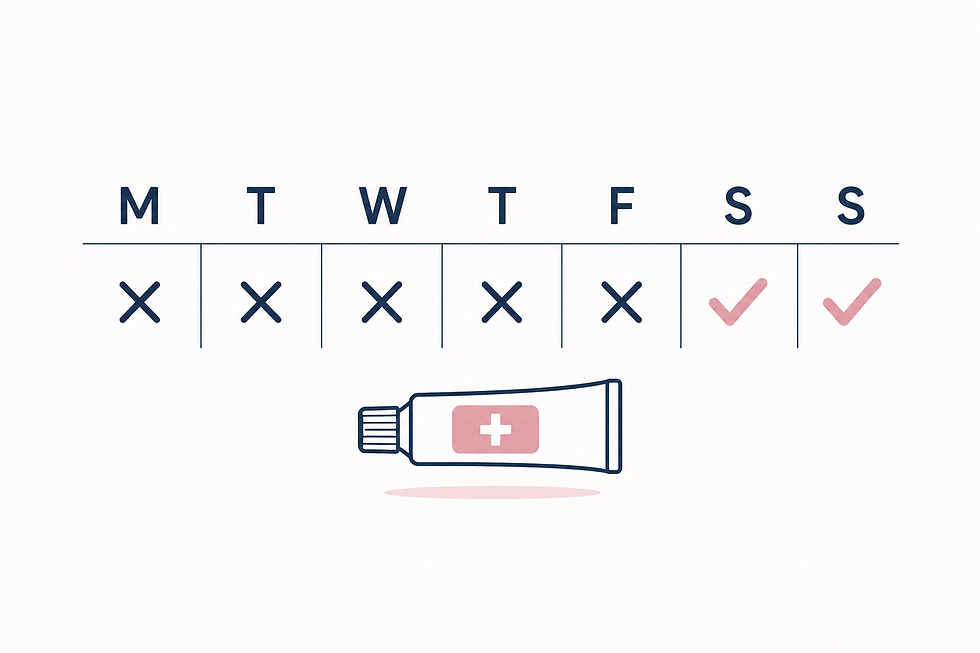
Use treatments only intermittently during severe flares
On the surface, these behaviours may appear like non-adherence. However, they are often driven by concern rather than disregard.
The clinical impact of undertreatment
When topical corticosteroids are not used appropraitely, eczema inflammation is not fully controlled.
This can lead to:
Persistent itch and sleep disturbance
Ongoing skin barrier damage
Increased risk of secondary infection
More frequent or prolonged flares
Over time, this cycle can significantly affect quality of life.
In some cases, the consequences of ongoing inflammation may be more significant than the potential risks of appropriately used topical steroids.
Where the communication gap occurs
A key issue is not only what is prescribed, but what is explained.
Patients are often told what to use, but not always given enough clarity around:
How much to apply
How long to continue treatment
What side effects are realistically expected
What is safe and what is uncommon
Without this context, it is understandable that patients may develop uncertainty or caution that leads to underuse.
Reframing steroid use
In many cases, corticophobia can be reduced through clearer education and reassurance.
This includes practical guidance, such as:
Demonstrating appropriate application amounts
Explaining fingertip unit dosing where relevant
Clarifying expected duration of treatment during flares
Discussing maintenance strategies once the skin improves
Reflection for practice
Corticophobia raises an important question for both patients and healthcare professionals:
Are treatment decisions being shaped by clinical evidence — or by fear and uncertainty?
Supporting patients to feel confident in using topical corticosteroids appropriately may be one of the most important steps in achieving better long-term eczema control.


Comments