
Weekend Therapy in Eczema: Maintenance Treatment After Flares
- Your Health Ally
- 1 day ago
- 2 min read
Eczema is often managed in two phases — treating active flares and then maintaining control once the skin improves.
In practice, most attention is placed on getting the flare under control. However, what happens after improvement is just as important in preventing recurrence.
This is where the concept of “weekend therapy” becomes relevant.
Why eczema often returns after treatment stops
Many patients understandably stop treatment once their skin looks and feels better.
At that point, the visible inflammation has improved, and continuing medication may feel unnecessary. However, eczema is not always fully resolved beneath the surface when the skin appears normal.
Subclinical inflammation can persist, meaning the skin remains vulnerable to relapse even after apparent recovery.
This contributes to a common cycle:
Flare occurs
Treatment is started
Skin improves
Treatment is stopped
Eczema returns
What is weekend therapy?
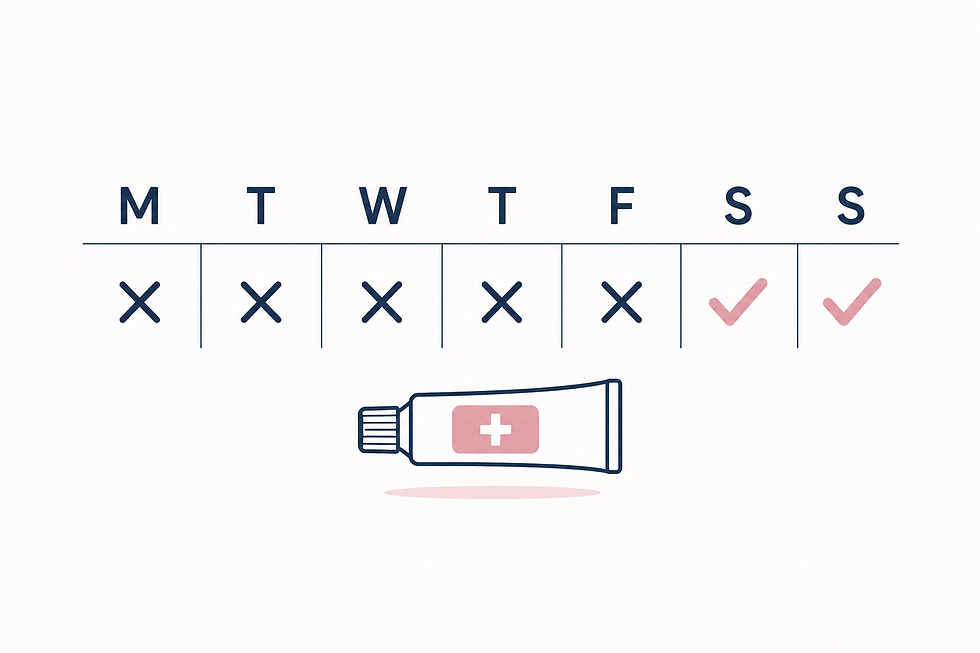
Weekend therapy refers to a maintenance approach where topical treatment is applied intermittently — typically on two consecutive days per week — after the eczema has been brought under control.
The goal is not to treat active inflammation daily, but to maintain stability and reduce the likelihood of relapse.
This approach is sometimes used in patients with recurrent or chronic eczema patterns.
Why maintenance treatment matters
Ongoing intermittent treatment may help:
Reduce frequency of flare-ups
Maintain skin barrier stability
Decrease the need for repeated intensive treatment courses
Improve long-term disease control
Rather than repeatedly restarting treatment from scratch, maintenance therapy aims to keep the skin in a controlled state.
The common gap in practice
Patients are often well informed about how to treat flares.
However, guidance on what to do after improvement is sometimes less clear.
Without a maintenance plan, patients may assume treatment should only be used during active symptoms.
This can unintentionally contribute to repeated cycles of relapse and retreatment.
Individual variation is important
Weekend therapy is not required for every patient with eczema.
Its use depends on:
severity of disease
frequency of flares
response to initial treatment
individual risk of relapse
For some patients, simple emollient use may be sufficient. For others, intermittent topical anti-inflammatory therapy may be needed to maintain control.
Beyond treatment: shifting the approach
One of the key shifts in eczema management is moving from a purely reactive approach to a preventive one.
Instead of only treating flares, the focus becomes:
preventing recurrence
stabilising the skin barrier
reducing inflammation over time
Weekend therapy sits within this preventative framework.
Reflection
A common question in eczema management is:
Are we only treating flares — or are we also supporting long-term control?
For many patients, stability comes not only from treating active disease, but from understanding what happens after the flare settles.
Final note
Always discuss your treatment options with your pharmacist or healthcare provider to ensure the approach is appropriate for your individual situation.


Comments